
For Polish job ads, our platform focuses specifically on legal compliance with Poland’s gender-inclusive and anti-discrimination regulations and government guidelines.
This means:
- We highlight and suggest improvements for non-compliant language
- We do not currently detect every form of non-inclusive or biased wording
- All suggestions are aligned with Polish legal and regulatory standards
Our goal is to help you publish job ads that meet official requirements while remaining clear, professional, and inclusive.
What you can do
Make your Polish job ads compliant with the latest gender-inclusive and anti-discrimination guidelines.
Nothing changes from how you normally use our platform (please see our Start Guide, if it’s the first time you’re using Develop Diverse):
- Log in, and click Create.
- Select Job Ad.
- Copy and paste your job ad into the editor.
- The platform detects it’s in Polish and suggests compliant alternatives based on your settings.
Give feedback
Use the Feedback button in the pop-up if:
-
You disagree with a highlighted term
-
You don’t understand why a phrase is flagged as non-compliant
-
The suggested alternatives don’t fit your context.
Gendered language settings (Admins only)
To align the alternatives we offer with your preferred gendered ending, you can change the settings for ‘Gendered Language’:
- Click on your profile icon in the upper right corner.
- Select Account Settings.
- Scroll to Inclusive Writing and find Gendered Language.
- Choose your preferred gendered ending for words referring to people (read more below).
- Save changes.
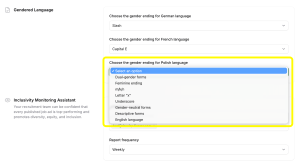
Gendered language options
You can choose from these formats:
- Dual-gender form: Uses a male and a female version separated by a slash symbol, e.g. “specjalista/specjalistka” for “specialist” and “kierownik/kierowniczka” for “manager”
- Adding a feminine ending, usually “/-a”: Adds a female version to the male version with a slash, dash and usually “a”, e.g. “księgowy/-a” for “accountant”
- ‘Default’ grammatical gender (masculine) in brackets followed by (m/k) or (m/k/n) for (m/f) or (m/f/n): e.g. “programista (m/k)” or “programista (m/k/n)” for “programmer”
- Letter “x” at the end of a word where x refers to any gender: e.g. “księgowx” for “accountant”
- Underscore (symbol: ‘_’) where x refers to any gender: e.g. “menedżer_” for “manager”
- Gender-neutral forms: e.g. ”Osoba na stanowisku …” (e.g. “Osoba na stanowisku księgowego” for “A person in the position of accountant”), “personel odpowiedzialny za … (e.g. “personel odpowiedzialny za prace ogrodowe” for “staff responsible for gardeining works”)
- Descriptive/functional forms: “koordynacja projektu” for “project coordination or “dział wsparcia” for “support department”
- English language: Job titles in English are permitted – Profession names in English should not change their grammatical form
In Summary
For Polish job ads, Develop Diverse helps you:
- Stay compliant with gender-inclusive and anti-discrimination regulations
- Apply consistent gendered language formats across postings
- Reduce legal risk while maintaining clarity and professionalism
Thank you for helping create fair and compliant Polish job ads!